Benny's Reports / Victoria Road Fines
The Speed Camera Report: Victoria
Originally published 18 May 2026
In 2024-25, 1.7M road infringement fines were issued in Victoria. Only 71k resulted in an official warning, a rate of 4.1%. That rate has not moved materially in five years of available data.
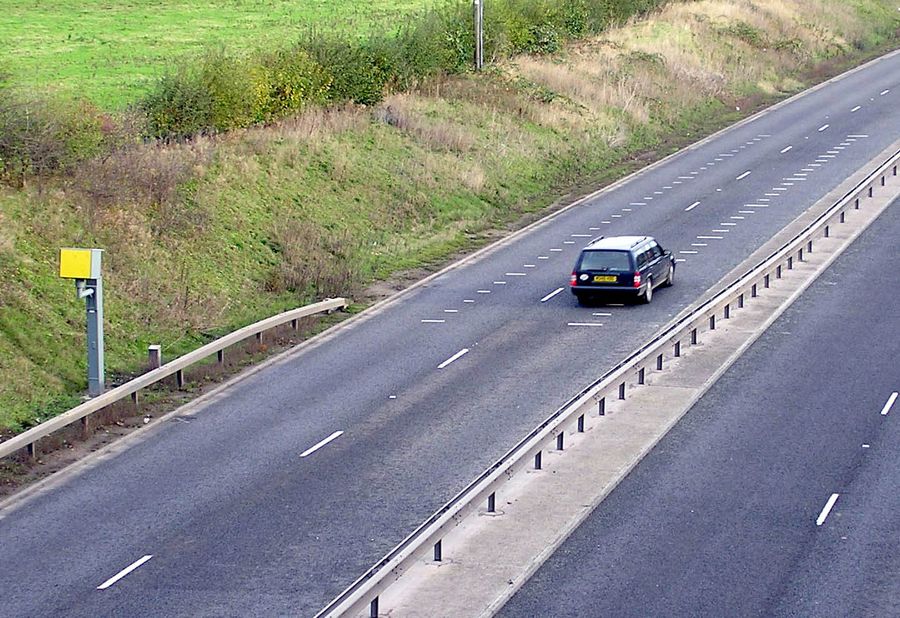
In 2024-25, 77% of speed camera offences (676k fines) were for travelling under 10 km/h over the limit, the category Victoria Police says may qualify for a warning. Yet the warning rate has sat between 4.1% and 5.2% every year since 2020-21, consistent across changes in fine volume and camera network size.
This report examines the structural features of how the system is administered: who issues fines, who decides challenges to those fines, where the revenue goes, and how each compares to other jurisdictions.
About this report
I'm Benny and I live in Victoria. I paid a speed camera fine in December 2025 and was confused. The notice didn't clearly explain my options. I tried to find out what they were. That made me more confused. The information wasn't where you'd look for it. The process wasn't where you'd expect it to be.
Then I found out why I was confused. That's when I got mad.
I was confused because I was still operating in good faith, assuming that if there was something I needed to know, it would be on the notice. That the system was designed to be understood. That the confusion was mine to resolve, not something built into the design. Looking at everything showed me exactly why it works the way it does. The confusion isn't a flaw. It's the mechanism. A $473M annual revenue stream that depends on most people not asking questions. A notice that doesn't mention your options. A review process decided by the agency that issued the fine. An oversight body that couldn't touch any of this, and that was abolished seven weeks before this report was published.
I looked into it. This is what I found. Everything is sourced from publicly available data, legislation, and government documents. Nothing here is inferred.
I'll be honest: writing and publishing this, part of me hopes I've got something wrong. Not because I don't trust the data. I do. It's all public record, anyone can verify it. But if what this report describes is accurate, that's genuinely worse than the alternative. I'd rather find out I misread something than find out it's exactly what it looks like. If someone at Victoria Police, Fines Victoria, or DJCS wants to show me where I've got it wrong, I'll update this report. That offer is genuine and open.
All figures are from publicly available Victorian Government datasets via data.vic.gov.au. Errors or corrections: contact@bennyrenya.com.
~629k speed camera fines were issued in the bracket where Victoria Police says warnings may apply. The warning rate that year: 4.1%.
That rate has stayed between 4.1% and 5.2% for five consecutive years. Fine volumes rose 43%. The rate did not move. The independent oversight body was abolished in March 2026. There is now no external check on any of it.
Methodology & sources
How to read this report
Primary data: Warning and fine counts from data.vic.gov.au (Cameras Save Lives, Dept of Justice). Compliance rates from the fixed-camera network 2016 to 2026.
Speed category data: The 77% under-10-km/h figure is from the FY2024-25 Speeding Categories (Fixed and Mobile Cameras) dataset published March 2026. It covers speed offences only; it excludes red-light and unregistered vehicle offences. The 676k under-10 km/h count is the actual recorded figure for that year, not a modelled proxy.
Warning gap estimate: The ~629k gap figure subtracts all 47k camera warnings issued in 2024-25 from the 676k under-10-km/h count. This assumes all camera warnings were for the under-10-km/h category. If Victoria Police issues warnings across other speed bands, this figure is smaller. It is a lower-bound estimate.
Scope: This report analyses publicly available data and documented institutional structure.
What you can do
If you received a speed camera fine for travelling under 10 km/h over the limit, you have options the fine notice does not mention.
Request an internal review
You have 28 days from the notice date to request an internal review through Victoria Police. The option is available for any infringement notice. It is not mentioned on the notice itself.
What to include: that this is a first or early offence, that you were travelling under 10 km/h over the limit, your prior driving history, and that Victoria Police's own published guidance states warnings may be considered for exactly this category. Ask them to apply that guidance.
Victoria Police is required to consider your request. They are not required to grant it.
If they say no
You can apply for a formal hearing at the Magistrates' Court of Victoria. This is a judicial process. Most people do not pursue it. Filing fees apply and the process takes time. That friction is part of why the internal review rate is low and the warning rate stays where it is.
The data
Five years of Victorian Government data. The warning rate has remained between 4.1% and 5.2% every year since 2020-21, consistent across changes in fine volume and camera network size. The charts below show warning and fine trends over time, how offences break down by speed category, and how camera compliance rates have shifted across the fixed-camera network.
System design
Three documented structural features of how the system operates.
1. The fine notice does not disclose warning eligibility
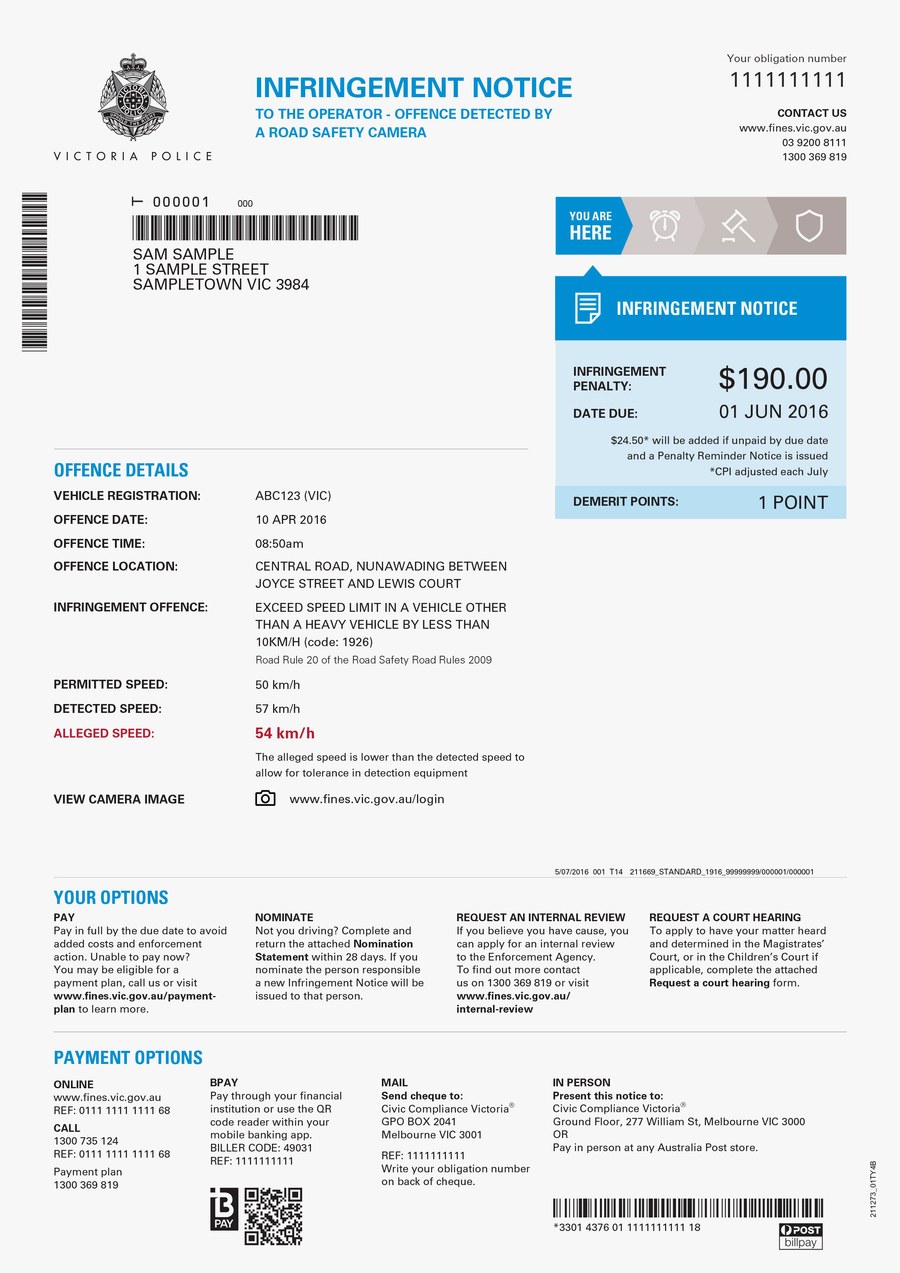
The infringement notice issued under the Infringements Act 2006 lists the offence, the amount, the due date, and payment options. It does not state that official warnings exist or that an internal review is free.[2] Victoria Legal Aid's published guidance covers all of this, but it is not referenced on the notice itself.
2. Internal reviews are decided by the same agency that issued the fine
Internal review applications for speed camera fines are decided by Victoria Police, the agency that issued the fine. Victoria Police states that decisions are made by delegated officers, not the officer who issued the infringement. The Infringements Act 2006 does not require the reviewing officer to be independent of the enforcement agency.[3]The Road Safety Camera Commissioner provides independent oversight of camera accuracy and placement but cannot overturn fines. There is no independent adjudicator at the first level of review.
3. The warning rate has not moved in five years
In every financial year from 2020-21 to 2024-25, the share of road fines that resulted in an official warning has been between 4.1% and 5.2%.[1]Fine volumes have changed. The camera network has expanded. The rate has not moved materially. Victoria Police says official warnings may be considered for speeds under 10 km/h over the limit, the category that accounted for 77% of all speed camera offences in 2024-25, or 676k recorded fines (FY2024-25 fixed and mobile camera data).
Who benefits from the status quo
The warning rate has stayed between 4.1% and 5.2% for five years. Three parties have an interest in that number staying where it is: two financial, one institutional. The Victorian Government and Verra Mobility lose revenue if the rate rises. Victoria Police would face a higher rate of successful challenges to its own decisions.
- Victoria Police decides internal review outcomes for fines it issued. A higher warning rate would mean more successful challenges to its decisions. Its decision record is not published.
- The Victorian Government receives all speed camera fine revenue. That revenue grew from $330M (2019-20) to $473M (2023-24), a 43% increase. A higher warning rate directly reduces it. The government both sets the legislative framework and receives the proceeds.
- Verra Mobility (NASDAQ: VRRM) operates Victoria's mobile camera vans under a contract whose value is not published. Their enforcement contract revenue depends on the program continuing at scale. A significant reduction in camera fine volumes would affect the commercial case for the contract.
Victoria Police decides these appeals and publishes no record of outcomes. There is no independent way to audit whether the 4.1% rate reflects consistent policy application.
Who pays
Speed camera fines are flat amounts set by offence category, not by the income of the person receiving them. The system does not adjust for capacity to pay. The same fine represents a different proportion of weekly income depending on who receives it.
A flat charge on unequal incomes
A $247 fine is not the same for everyone. For someone earning the state median income, it's an inconvenience. For someone earning $437 a week in Coolaroo or $444 in Campbellfield, the suburbs with the highest infringement rates in 2023, it's more than half a week's income.[8] The fine does not know the difference. The system does not adjust.
A 2024 report by The Australia Institute, commissioned with Uniting Vic Tas and Financial Counselling Victoria, named this explicitly: Australia's flat fine structure is a regressive charge.[7] The same dollar amount extracts a larger share of income from the people least able to pay it. New South Wales applies a 50% reduction to most fines for eligible Centrelink recipients under Revenue NSW's 50% reduction scheme. Victoria does not.
Finland calculates speeding fines as a proportion of weekly income under its long-standing day-fine system. Australia has no equivalent at any level of government. The structure that exists is not an accident. It is a design choice that has never been revisited for Victorian speed camera fines.
Where the cameras are placed
A 2024 analysis by The Citizen and Junction Journalism cross-referenced 161 AI mobile camera sites against 2021 Census median weekly income by suburb.[8] 54% of those sites were in suburbs with below-median weekly household income. The highest infringement rates in the second half of 2023 were in Coolaroo (median weekly income: $437) and Campbellfield ($444), against a state median of $803. Inner Melbourne suburbs with incomes above median had no camera presence in the dataset.
This analysis covers AI mobile phone and seatbelt cameras, not speed cameras specifically. The speed camera map further down this page lets you examine the fixed speed camera network directly.
What happens when you can't pay
An unpaid infringement notice escalates under the Infringements Act 2006: enforcement order, additional fees, licence suspension, sheriff referral. Each step adds cost to the original amount.
The Work and Development Permit scheme lets eligible people discharge fines through unpaid work, treatment programs, or mentoring instead of payment. Eligibility is limited to people experiencing financial hardship, mental illness, serious addiction, or homelessness.
| Year | WDP approvals | Change |
|---|---|---|
| 2020-21 | 1,684 | base |
| 2021-22 | 1,603 | -4.8% |
| 2022-23 | 2,695 | +63.3% |
| 2023-24 | 4,414 | +68.7% |
Source: DJCS Annual Reports on the Infringements System.[9] The Victorian Government has not published an explanation for the two-year acceleration. Possible causes include cost-of-living pressure driving more referrals from community organisations, a policy change broadening eligibility, or a backlog from prior years clearing. The data records that it happened. The context is not public.
The Victorian Ombudsman's 2019 investigation found Fines Victoria was the third most complained-about government agency in Victoria, with 605 complaints in 2018, a 74% increase on the predecessor agency. People on Centrepay, a direct-debit service used by Centrelink recipients, were disproportionately affected by payment processing failures that generated escalation notices despite payments having been made.
Revenue structure
Under the Transport Legislation Amendment Act 2019, all speed camera fine revenue flows into the Better Roads Victoria Trust Account, designated for road infrastructure and road safety. Total revenue in 2023-24 was approximately $473M[4], roughly $107 per licensed Victorian driver, with no published breakdown of what each dollar funded.
Designated spending categories under the 2019 Act. Of the $473M total, an estimated $155M came from lower-range fines, estimated from Victoria Police's published speed category data. Source: vic.gov.au/revenue-fines
What the Trust Account does and does not publish
The Better Roads Victoria Trust Account has a published annual intake and a legislative spending mandate. It does not have a public expenditure ledger. The Victorian Government publishes no annual statement of what the account disbursed, on which projects, in which year.
The Victorian Government has not published whether camera fine revenue increases total road spending, or simply offsets general revenue that would otherwise fund the same projects. That question cannot be answered from anything currently published, because the government has chosen not to publish what would be needed to answer it.
The US Highway Trust Fund publishes receipts and expenditures itemised by state and category in the Federal Highway Administration's annual Highway Statistics report. The UK's National Roads Fund reports annually to Parliament with receipts and expenditure reconciled against ring-fenced commitments. The Victorian Auditor-General's 2009-10 Road Safety Camera Program audit acknowledged the account as the revenue destination but assessed camera accuracy and placement only. No subsequent audit of how the account's money was spent, or whether it actually increased road funding rather than replacing it, has been published. The Victorian Auditor-General has not audited the Trust Account since it was created in March 2019. The closest available expenditure disclosure is an appendix in the Department of Transport and Planning's annual report, available only as a large PDF in Parliament's tabled papers and not indexed or summarised in any accessible public form.
Private contractor: Verra Mobility
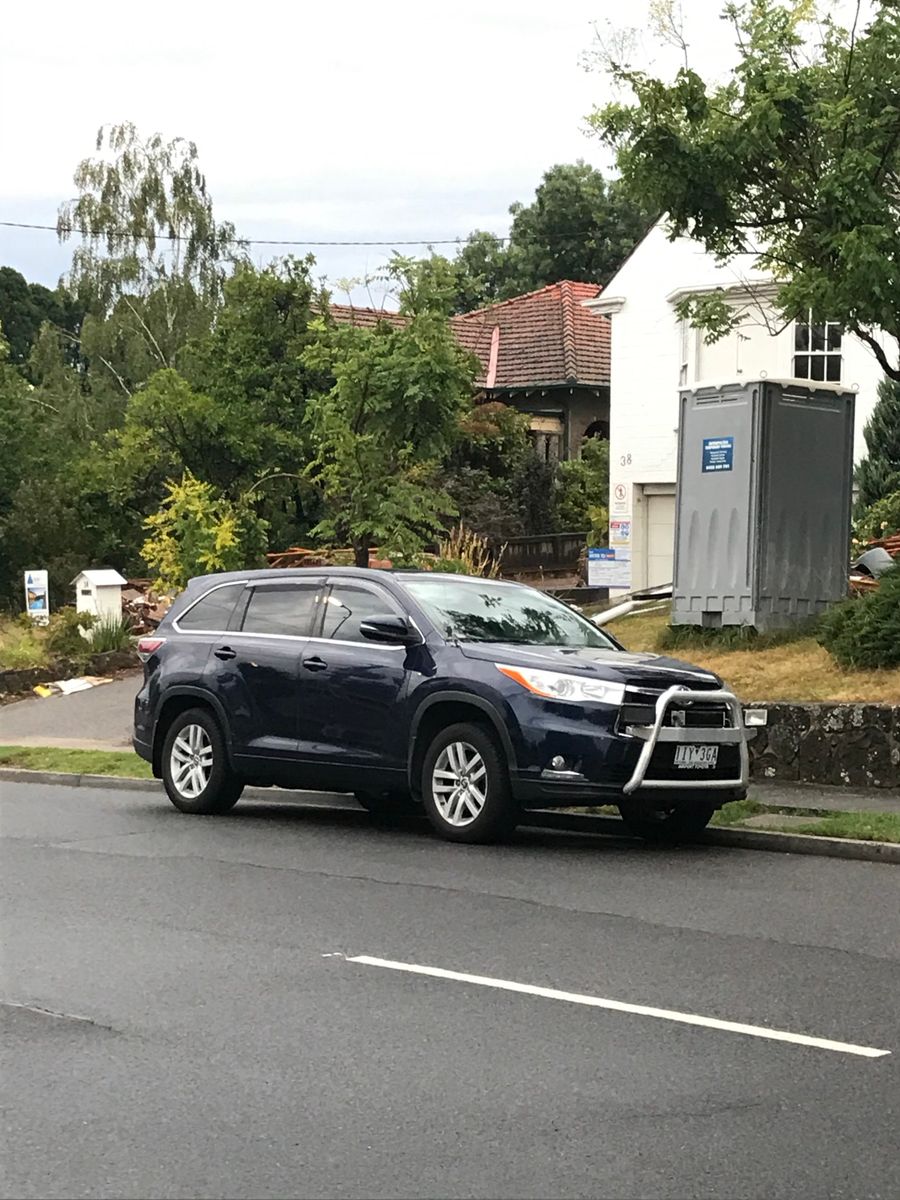
Victoria's mobile speed camera vans are operated under contract by Verra Mobility (NASDAQ: VRRM), a US company headquartered in Arizona. In 2021, Verra Mobility acquired Redflex Holdings, the Melbourne-founded company that had operated Victoria's mobile camera network since the program's inception. Redflex was delisted from the ASX following the acquisition.[5]In 2015, Redflex's US subsidiary CEO Karen Finley pleaded guilty to conspiracy to commit bribery, having channelled payments to Chicago city officials to secure red light camera contracts. Redflex paid $20 million to settle with the City of Chicago. The misconduct was at the US subsidiary level. The Australian parent cooperated with federal prosecutors. No equivalent proceedings were brought in Australia.
Victoria's fixed digital cameras are government-owned infrastructure operated and maintained under separate contractual arrangements. Verra Mobility's government solutions division operates automated enforcement programs in multiple countries under long-term government contracts. The value and duration of Verra Mobility's Victorian contract are not published in accessible government procurement records.
The contract was not publicly retendered following the 2021 acquisition. Whether it was novated, extended, or renegotiated as part of the Redflex transaction is not disclosed in any accessible Victorian government procurement record. The department responsible for contract oversight, and whether any independent review of the contract terms occurred post-acquisition, has not been publicly confirmed. Verra Mobility discloses segment-level government solutions revenue in its annual SEC 10-K filings; the Victorian contract is not separately line-itemed.
In September 2025, Verra Mobility began a four-week technical trial of next-generation trailer-based cameras on Canterbury Road, Albert Park. Unlike the existing mobile camera vans, which detect speed only, the trial cameras detect five offence types: speed, red light, bus lane, seatbelt non-compliance, and mobile phone use while driving. The Victorian Government described the trial as “an essential step for generating the insights needed for future deployments across Victoria.”
Federal money fixes the roads. State money fines the drivers.
The 2026-27 Australian Federal Budget allocates $48M to upgrade 60 Victorian black-spot locations under the Australian Government Black Spot Program[11]. The federal Safer Local Roads and Infrastructure Program rises from $201.5M to $330M nationally. Roads to Recovery gains an additional $109M. Federal road spending is increasingly engineering-led: reduce harm by changing the road.
Victoria's speed-camera revenue in 2023-24 was approximately $473M, roughly ten times the federal Black Spot allocation for the state in 2026-27. State revenue is enforcement-led: reduce harm by penalising the driver. The two approaches are not mutually exclusive, but the Victorian Government has not published whether camera revenue increases total road spending or merely offsets general revenue that would otherwise fund the same projects (already noted under Revenue structure).
The Federal Budget contains no measure affecting state speed-camera regimes. No hypothecation rule. No enforcement standard. No independent-review requirement. Speed-camera policy sits entirely with the Victorian Parliament under the Infringements Act 2006. Whatever the Commonwealth funds in physical road safety, the state's enforcement-revenue mechanism is unaffected by it.
Other places solved this. Victoria hasn't.
Independent review of traffic fines is not a novel idea. Other jurisdictions built it decades ago. Victoria has not.
Traffic Penalty Tribunal established 1993[6]
Drivers appeal to an independent adjudicator not employed by the enforcement agency. The adjudicator's decision binds the authority. No court proceedings required.
Constitutional right; OWiG 1968
Fines contested before an independent administrative court. Full disclosure of camera calibration records, operator qualifications, and measurement methodology can be compelled. Burden of proof sits with the enforcement authority.
Centrelink discount; still same-agency review
NSW applies a reduced penalty for Centrelink recipients, a partial step toward proportional fines. Internal reviews are still decided by the issuing agency. No independent adjudicator equivalent to the UK model.
Where are the cameras?
Victoria has 287 fixed digital speed cameras. The map shows 277 of them; the remaining 10 are inside tunnels (CityLink Burnley and Domain) and cannot be geocoded to a surface location. All positions are suburb-level approximations. Click a dot to see the listed location. Mobile camera zones are not shown as they rotate between approximately 2,000 approved sites.
277 fixed speed cameras across Victoria
Interactive map with OpenStreetMap tiles
Fixed digital cameras only. Mobile camera zones are not shown as they have no fixed location. Source: data.vic.gov.au (Cameras Save Lives / Dept of Justice & Community Safety, CC-BY 4.0). Map tiles: OpenStreetMap contributors.
Right of reply
The following questions were sent to Victoria Police, Fines Victoria, and Verra Mobility on 12 May 2026. The response deadline was 18 May 2026. No responses were received. If any organisation responds after publication, this section will be updated.
Questions sent: 12 May 2026. Response deadline: 18 May 2026. No responses received.
Victoria Police
- What is the total number of internal review requests received for speed camera infringements in each financial year from 2020-21 to 2024-25?
- Of those requests, how many resulted in the fine being withdrawn and a warning issued, broken down by year?
- What criteria does Victoria Police apply when deciding whether to grant a warning rather than uphold an infringement?
- Why is the warning eligibility guidance not included on the infringement notice itself?
Fines Victoria
- How many internal review requests for speed camera fines were lodged via Fines Victoria in each year from 2020-21 to 2024-25?
- What is the explanation for the 68.7% increase in Work and Development Permit approvals in 2023-24?
Verra Mobility / DJCS
- What is the value and duration of Verra Mobility's contract to operate Victoria's mobile speed camera vans?
- Was the contract publicly retendered following Verra Mobility's acquisition of Redflex in 2021?
- Which department is responsible for contract oversight and performance review of the mobile camera operator?
Questions about the system
Documented answers to structural questions about how the fine and review system operates.
What happens if you don't pay?
Under the Infringements Act 2006, an unpaid infringement notice escalates through a documented enforcement sequence. Fines Victoria issues an enforcement order, which adds additional fees to the original amount. If that remains unpaid, further enforcement can include driver licence suspension, vehicle registration cancellation, referral to the Sheriff's Office for a warrant, and civil debt recovery. The matter can also be referred to Magistrates' Court. Each escalation stage adds cost and administrative burden on the recipient. The same review options (internal review, court election) remain available at the enforcement order stage, but the window to use them is limited and the consequences of missing it are compounding.
Who decides a speed-camera internal review?
The decision sits with the enforcement agency, usually Victoria Police. Victoria Police states that review decisions are made by delegated officers, not the officer who issued the fine. The process is governed by the Infringements Act 2006. The Act does not require the reviewing officer to be independent of the enforcement agency. Fines Victoria administers the process but does not make the decision.
Where does speed camera fine revenue go?
Under the Transport Legislation Amendment Act 2019, all speed camera fine revenue flows into the Better Roads Victoria Trust Account, designated for road infrastructure. The Victorian Government reports total intake ($473M in 2023-24) but publishes no annual statement of disbursements, project-level expenditure, or comparison against what road spending would have been without the dedicated fund.
How many people request internal reviews, and how many succeed?
Victoria Police does not publish internal review outcome data. No annual report, ministerial brief, or public dataset documents how many speed camera internal review applications were received, how many resulted in a fine being upheld, reduced, or converted to a warning, or what grounds were most commonly cited. This absence is itself a structural feature of the system: the body that decides reviews is not required to publish its decision record. The Road Safety Camera Commissioner publishes annual reports on camera accuracy and placement but does not compile or publish review outcome statistics.
Test your knowledge of the system
10 random questions drawn from the data. How much do you actually know about Victoria's speed camera system?
General information only - not legal advice. Seek a qualified lawyer or call Victoria Legal Aid (1300 792 387) for serious matters.
Key organisations
Administers the infringement system, payment, enforcement stages, and the review process
Issues speed camera fines; decides internal review outcomes for speed camera infringements
Provided independent oversight of camera accuracy and placement; could not overturn fines. Abolished March 2026; oversight transferred to DJCS.
US company (NASDAQ: VRRM) operating Victoria's mobile speed camera vans under contract; acquired Redflex in 2021
Melbourne-founded camera contractor; original operator of Victoria's mobile camera network; wholly owned subsidiary of Verra Mobility since 2021
Handles complaints about Fines Victoria administration; cannot override Victoria Police review decisions
Judicial review of infringements; requires formal proceedings
Publishes public guidance on the review process; duty lawyers available at all Magistrates' Courts
Notes
- 1.Victorian Government road safety camera fine and warning data, FY2020-21 to FY2024-25. data.vic.gov.au: Road Safety Camera Network Infringements (Cameras Save Lives / Dept of Justice & Community Safety, CC-BY 4.0). ↩
- 2.Infringements Act 2006 (Vic), s.13, prescribed content of infringement notices. legislation.vic.gov.au. ↩
- 3.Victoria Police published guidance on internal review process, including delegated officer structure and warning eligibility criteria. police.vic.gov.au. ↩
- 4.Transport Legislation Amendment (Better Roads Victoria and Other Amendments) Act 2019 (Vic), s.3, establishment and purpose of the Better Roads Victoria Trust Account. legislation.vic.gov.au. Revenue figure ($473M, 2023-24) from vic.gov.au/revenue-fines. ↩
- 5.Verra Mobility Corporation acquisition of Redflex Holdings Limited, completed 2021. Redflex delisted from ASX (RDF) following completion. verramobility.com. ↩
- 6.Traffic Penalty Tribunal (UK), established under the Road Traffic Act 1991 and subsequent regulations. trafficpenaltytribunal.gov.uk. ↩
- 7.Chollet O., Thrower J., Grundy A., Refining Fines, The Australia Institute, October 2024. Commissioned with Uniting Vic Tas and Financial Counselling Victoria. australiainstitute.org.au (PDF). ↩
- 8.“New AI traffic cameras sting low-income Victorians most”, The Citizen and Junction Journalism, 2024. Methodology: 161 AI mobile camera sites cross-referenced against 2021 Census median weekly household income by suburb. rightnow.org.au. ↩
- 9.Department of Justice and Community Safety Victoria, Annual Reports on the Infringements System, FY2020-21 to FY2023-24. WDP approval figures: 1,684 (2020-21), 1,603 (2021-22), 2,695 (2022-23), 4,414 (2023-24). justice.vic.gov.au. ↩
- 10.Road Safety Camera Commissioner Act 2011 (Vic), repealed March 2026. Position vacant from 31 October 2025; office abolished by the Victorian Parliament. Oversight transferred to the Department of Justice and Community Safety. vic.gov.au/road-safety-camera-system-oversight. ↩
- 12.Road Safety Camera Commissioner investigation into 40 km/h speed zone, Davey Street intersection, Nepean Highway, Frankston, 2022. Commissioner Taylor found signage was inadequate. Victoria Police withdrew approximately 40,000 infringement notices for offences between 15 April and 16 June 2022. Reported in RSCC Annual Report 2022-23. ↩
- 11.Australian Government 2026-27 Federal Budget, delivered 12 May 2026. budget.gov.au: Budget papers. Black Spot Program 2026-27 Victorian allocation ($48M, 60 locations) per infrastructure.gov.au. Safer Local Roads and Infrastructure Program and Roads to Recovery uplift figures per NRMA budget summary. ↩
Support this work
Reports like this take time to research and build. A small donation helps keep them coming.